Sunday, 2 September 2018

Inn & Marcantile at Ojo Caliente

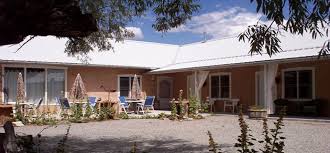
The little, six-room B&B just outside the gate of the main spa is a real favorite. The rooms are comfortable and free of TV. No other appliances either, but guests are welcome to use the adjacent kitchen, which has everything. Pleasant indoor and outdoor sitting and breakfast tables.
Image result for inn and mercantile at ojo caliente


The breakfast is really fine. Deserves to be called gourmet, because much is home-grown as well as home-made. It's different every day, and personally prepared by a friendly staff - and sometimes by the owners. These two ladies have been here for a long time - as I can attest from frequent stays. This time I learned from one of them that the little fruits on the counter were not grapes, but plums. indigenous, pre-Colombian plums, Image result for prunus americanuswhich she has cultivated and turned into jams and syrup of gluten-free pancakes. Then there were her peaches. Maybe not indigenous, but really delicious, grown in her own orchard.  The small peaches - like wild strawberries - gain in flavor what they lack in dimension. Best I have ever tasted, I think.

Image result for inn and mercantile at ojo calienteTo top it off,, there is a lively, old, adobe church right across the street. 

Saturday, 1 September 2018

San Luis and Rabbit Brush

The San Luis Valley is a high (almost 8,000 feet) park between the San Juan and the Sangre de Cristo ranges, where the Rio Grande rises. It is amed for the little town near the New Mexico border, which is the oldest in Colorado. I drove so9uth from Salida Springs through this kind of landscape:

Image result for Silver Leaf Rabbitbrush.
Rabbit Brush is in full bloom this time of year, turning the valley floor gold.

The Sangre de Cristo are my favotrite mo9untains, stretching from SantaFe on the southern end north to this vallet. The main Co9lorado peak is called Blanca because itis often white from top to the vallet floor. Not now, though. Bare because of little precipitation, although there was a smattering that turned it white for me in the afternoon.

I think Blanca is my favorite mountain. For me, it marks the furthest extent of the Spanish Empire in the new world. .It is also the highest of the range, at 14, 344 feet:


Image result for Blanca Peak

The Spanish neer settled the area, though. They set it aside for the Ute people. AFter we took it from the Mesxicans in 1848, farmers, the Utes were driven away and Spanish farmers from further so9uth were recruited. San Luis was incorporated in 1851. This was also the time of the arrival of the first RC Bishop  of Santa Fe, Jean Baptiste Lamy who founded a number of parishes (San Acacio, San Antonito, San Luis, San Pedro y Pablo), which still have hamlets named for them. Lamy came from Clermont-Ferrand via Cincinnati. Willa Cather's Death Comes to the Archbishop is based on his ministry. Until then, the nearest bishop was in Chihuahua, and things got a little rough in New Mexico


Virgo de San Acacio - oldest church in Colorado.

Among other things, there arose a society of flagellants called penitentes, which Lamy tried to supress - unsu8ccessfully. They went undergro9und until they were later reconciled, agreeing to tone down some of their practices.  Their muradas, windowless meeting halls, are still to be seen.

Image result for spmdtu
The San Luis Valley is also home to a society called S.P.M.D.T.U., a Hispanic labor union founded in 1900 and still going.

At one poinbt while exploring these towns, I had to stop for a herd of cows, driven by cowboys and cowgirls on ATVs!

Then on to Ojo Caliente, named by the first European to see it, Alvar Nunez Cabeza de Vaca in 1536. He had been shipwrecked in Florida, and somehow made his way to New Mexico! When he arrived, the spring was already sacred to the Indians. [There is a pretty good eponymous  movie about this. The Indians 0of Ojo Caliente look like lepers, because of their salutary habit of mud-bathing.]

Now, Ojo Caliente is a fancy spa, with several different kinds of mineral bathsk, icluding iron and soda (magnesium) the oldest, arsenic, and lithium,, in addition to llarge heated pools. Mud bathing is still offered. All with the pleasant aroma of pinon from the fireplaces in the air.

Image result for ojo caliente Arsenic pool at Ojo Caliente

So, the sun has come out, and it iis time to bathe!

A big cloudburst with lightning shut down the outdoor baths - they are afraid of lightening, I guess. I had  more than two hours of soaking, though and that it enough for today.


Thursday, 30 August 2018

North Platte to Boulder to Salida Springs.

The scenery changed abruptly at the Colorado border, from woods along the river to high plains barren. Got to Boulder early and spent the afternoon with the deRaismes. Rick Moody came over to talk for awhile and it was moist enjoyable.

I went on to Idaho Springs for a soak in the old spa there, and a restful night. Then off this morning through Breckenridge and over Hoosier Pass (>11,000 ft). VERY slowly because of a big semi and no passing on the road. OK with me - more time to observe the scenery, including a view of Pike's peak on the descent.. Slight giddiness from the altitude.

No room in Buena Vista, so I went on to Salida, where there is a nice spa and indoor pool. So I will skip Mt. Princeton and go on to Ojo Caliente tomorrow, I think. Labor Day weekend may be causing a problem with rooms.

Aspens are turning - some in full bloom.
Image result for rocky mountain aspens

Tuesday, 28 August 2018

The Baths of New Mexico and Colorado

[This was to have been posted in the Winter of 1917, but I didn't, for some reason. My new posts begin with the one previous to this, and then continue, as I write them.]

Having neglected this log for three years, I find that I now want to record the delights of a trip up the Rio Grande in search of hot springs.


Pagosa Springs

In the San Juan Mountains, along the eponymous river (a tributary of the Colorado, which joins it above the Grand Canyon) that is just as wide as the Rio Grande, a town grew up around a hot spring beside the river, named after the nearby Pagosa peak., When the spa was quite humble. Now there is more than one to choose from, and all are quite luxurious.

I remember the old one, which I visited yesterday, was just one indoor hot pool, with a tiny, long, rectangular room through which hot water was piped so as to produce a steam bath. After getting hot enough, it was possible to run across the parking lot and jump into the San Juan! You can do that anymore, but right across the street, there is a new spa with lots of outdoor pools and steps leading right down into the river. The hottest pool is 110° and the river must be below 40°. That makes for a nice and/or fun-rash and wonderful, skin-tingling sense of healthy well-being. I suppose some might question my doing this at 74, but if it kills me at least I will have died happy! The euphoria of lying, in my bathing suit, in the sun, at 7400 feet, having just climbed out of that river, inches away, is not to be forgotten.

With three people from Fort Worth. I told them all about truth or consequences. Then another, older man joined us and somehow the conversation turned to our halfwit President. I just listened for quite a while, but finally — as in one of the psalms — I could hold my tongue no longer. I asked them to listen what I told him what it was like in Minnesota. Our Somali people are fleeing to Canada. How immigrants are afraid to go to a parent-teacher conferences, because they might be disappeared. How the Halfwit stopped at our airport a week or so before the election just to threaten the Somali community.

This was my first — and so far my only — direct contact with Halfwit-supporters. What is really frightening about it was a personal confirmation of what we've been hearing on the news: people simply have contradictory views of reality — alternative realities. The major media are all liars — exactly, I have to observe, what I think of people like Rush Limbaugh and the Halfwit himself. The older man fears there may be a civil war. This conversation somewhat marred my euphoric reveries in this otherwise lovely place.

I did not remind them that Colorado was a blue state.
It is amazing to me that I haven't visited this site for four years! Anyway, thanks for your interest,, and I will try to post something every day or so. For now, here is a picture of a Sand Hill Crane, of which population North Platte Nebraska claims to be the capitol:

Image result for sandhill crane

Thursday, 27 March 2014

Spring in Tucson

It is, of course beautiful and sunny. The bad news is that there is a really serious drought. The desert doesn't look good. really thirsty and not many flowers.

In town, where people water, it is a different story, naturally. here are some shots of my host's patio:


Tomstone Rose.
Nancy's  hedge, overgrowing her south fence. The Lady Banksia, originally from Scotland, proves very adaptable, flourishing in the desert. The largest rose bush in the world is of this variety, in Tombstone, hence the nickname. [Enlarge this to get the full effect.]

Monday, 24 February 2014

Ka'u & Kona Coffee

St. Jude's Guatemalan neighbor has a small roasting operation. He showed it to me today. he biuts most oof his beans from growers all over the island then roasts and packages them to order for vendors here and on the mainland. He paclaged up two ro three pounds each of Kona, Ka'u naturalmente (a rought version, with lots of black ones that have to be removed before roasting), and Hawai'ian Blend, which is very clean, prepared for mainland sale. he added a pound of fine Ka'u peaberry and then refused any hint of payment. (At retail prices this would be well over $200 worth!)


I let him do this because arguing is indecent, people know how to treat clergy in his culture, and he is actually doing quite well. His shop is pretty extensive, he sells all over the world, and his house, though modest, looks quite comfortable, and he appears to have a swimming pool for his three boys! He has been here in Ocean View for the past twelve years.

Thursday, 20 February 2014

Mahina

If you ever find yourself in Captain Cook, HI (just south of Kona on the Big Island), don’t miss the Mahina Café, and be sure to try the Hawai’ian Plate – a tasting menu of indigenous foods – mostly pork, cooked in various ways that taste really distinct. Mahina means “moon”, as our server explained. Rachel is a native Hawai’ian, who is very well-informed about the state’s history. The indigenous people have a lunar calendar, much like the plains Indians, in which each moon has a name. Together with the stars, especially the Pleiades, the moons guide the agricultural life. (We are now in the Harvest Moon.)
                Rachel explained that pigs came to the islands (along with dogs, taro, and bananas) with the very first settlers, whose origin is unknown – somewhere in Polynesia, around 1500 years ago.
Replica of ancient Polynesian ship
The various dishes in the sampling plate are traditional to the luau, and traditionally cooked underground.

Upper right: shredded pork and beef (laulau), wrapped first in taro leaf and then in ti leaf for underground cooking.
Lower-left, shredded pork. White cube, taro-root flan.
One of them is smoked with the wood of a Hawai’an tree similar to mesquite. It produces prickly thorns, however, and the native joke is that the Europeaans brought it not just to feed the cattle with its beans, but to force the Hawai’ians not to go barefoot!
                I told Rachel about Bishop Whipple and our devotion to Queen Emma. She seemed happy to hear it. She observed that the conquest of Hawai’i followed immediately upon the subjugation of the plains Indians, and the history (deracination, linguistic suppression, deportation, and boarding schools) was similar. She also pointed out that by the end of the 19th century, there were only about 40,000 Hawai’ians left. Since most of the were eope of some meansa, there are plenty of pretenders, nowadays, to chiefdom (ai’i) and royalty. Most well-known is Prince Quentin Kawananakoa,

File:Royal Heirs To The Hawaiian Kingdom The House of Kawananakoa, 2013 King Kamehemeha Parade, crop.jpg
Vesture is royal, rather than academic, I think (see below).
Also heir to one of the largest mainlander planters (James Campbell), Prince Kawananakoa was a member of the State Legislature and erstwhile minority leader. He has never been elected to national office, perhaps because he is a Republican, which seems a little odd for a royal pretender!
                Possibly because of this kind of anomaly, a cousin of Kamehameha the Great, five times removed, Prince Noa Kalokuokamile  (Kalokuokamile  III) is supported by some. .


Wednesday, 19 February 2014

Coffee Roasting and Witness Protection

So  it does rain here. Technically a desert, this part of the island got plenty of rain in the last couple of days - cold and grey, too. Anyway, it's still beautiful.

My friend, Sharif, went to visit friends at the north end and came back with the news (rumor) that Ocean View has a lot of Witness Protection Program clients. I wonder, if it's so well known, whether it's really that safe for them! OceanView also has a reputation of being armed to the teeth!


Who knew?

We roasted some green Ka'u peaberries today - really good.


It has been at least 20 years since I roasted my own coffee During that time, I acquired a perfect roasting-pan - a heavy aluminum, camp-style, folding omlette pan, with the wooden-insulated handles extending "from the diameter, not the radius" as the late Don Lohr (our coffee guru) used to say.


These are somewhat hard to come by nowadays. This was the first time I had used the pan, which my friend Virginia Howell got for me at the Berkeley Ashby Bart Saturday flea-market many years ago. It works like a dream. McKinnie Place has an outdoor, gas BBQ which was also perfect.


Only a week t go here in Ocean View, and then I will spend a few days looking around Hawai'i before returning to Tucson. then I plan to go to Berkeley for a couple of weeks.

Saturday, 15 February 2014

Showers

St Jude's offers free showers for all comers on Saturday mornings, complete with a complimentary soup lunch. Lots of takers, because many people live here without running water. There are many Marshal Islanders, who are among the most destitute.


These kids look just like our patrons.


Wednesday, 12 February 2014

Ka Lae


South Point is the imaginatively named southernmost point in the United States. At latitude N. 18.9111, which places it roughly parallel to northern Yemen and Taiwan. It is also a place where poor crazy people jump off the cliff. The park service considerately provides a ladder for them to climb back up,


Prescinding from these delights, I contented myself with admiring the incredible blue of the Pacific here a short way from the house at St. Jude's.

********

Later, I listened to Amy Goodman online, to learn about the kick-off of The Intercept, Glenn Greenwald's new online journal in collaboration with Jeff Scahill, Laura Poitras, and the E-bay magnate. Everyone should follow it. Or listen to or watch the Democracy Now interview with them (scroll down to third video).


Monday, 10 February 2014


Displaying 20140209_140322.jpg

Drove up the east coast to a black-sand beach (below). Beautiful day. Typical view, above.

Displaying 20140209_132748.jpg

As you can see, the sand is pulverized lava. Nice little waves - not much surf for the real aficionados, but great for children.

Friday, 7 February 2014

Kilaulea


Kilaulea is a volcano in its own right, erupting out of the side of Mauna Loa near the sea. It doesn't look like this right now, although it is permanently belching brimstone into the air in huge quantities. I tasted the Vog (yes, tasted) yesterday when I drove up to Hilo to pick up my friend Sharif at the airport. On the way back, we stopped in at Volcanoes National Park, where a nice ranger directed us to the caldera of the active volcano, which now looks like this:


At night it is supposed to be pretty red - reflecting the magma below. From time to time it spills over and they have to evacuate a town. 


But now there is nothing much between it and the ocean.


HI Rt. 11 (the Kamehameha Highway, which circles the island) runs north of it, just up the mountainside. 

There are plenty of chthonic spectacles everywhere, including dozens of steam vents that make the landscape look pretty infernal - like Yellowstone only more so - steam rising out of the ground everywhere you look.


************************

I had my first "bible study" today, with the men's group. Very interesting people. It was a privilege to hear their spiritual journeys. We didn't pore over text so much, but talked about our own experience and convictions, with occasional reference to the Holy Scripture. 

Tuesday, 4 February 2014

Hula


Among many bad things done by the American missionaries was the banning of Hula. I suppose it was because of its pagan connotations, praising gods and telling epics and legends. Maybe also because the women were topless, except for leis, and the swaying hips were thought lascivious by the puritanical Yankees. Anyway, I remember the latter idea from my youth, when people would wink and scoff at the notion that “it’s all in the hands.” The idea that there was something venereal about Hula probably persisted in the minds of the young sailors, who saw it when it was revived.
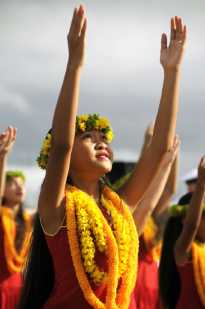
But it is anything but an erotic dance. The local parish Hula troupe danced at Mass last Sunday. It was really uplifting, the story enacted was our Lord’s encounter with the rich young man. Every gesture of hand and foot and hip has a sign-language meaning, interpreting the words of the song that is being sung (in this case a record). It is hard to convey how gentle, beautiful, and gracious it is. A great many hymns and Biblical passages are now choreographed this way.


The Parish Hula group is exclusively Kapuna (seniors over 60). Both sexes.The eldest is a lovely Japanese lady of 85. All of them sway like palm-trees in the breeze and make the complicated, flowing gestures together. St. Jude’s troupe is getting ready to dance for the Bishop, when he visits on my last Sunday here. They also compete regularly in Hilo and elsewhere. It is a very big deal here.
Hula is more strenuous than it appears. I went to practice and joined in. I had to sit out after the first dance, though – winded and tired already. One of the women said it was “much better than yoga.” She also claimed that it had great spiritual benefit, which I can believe. In any case, I can’t imagine anything more reverent or dignified.
There are secular Hulas, too – songs about love and fishing and travelling and history. But in church, it’s all religious.  Check out this link. They sing first and then start dancing. 

Here's another one, in the traditional style, chanted without musical instruments. It was composed to cheer up Anglican Queen Emma, after the death of her child and husband.

Finally a secular Hula, with typical yodeling song and instruments.

Sunday, 2 February 2014

St. Jude's Ocean View

St. Jude’s has exceeded my expectations in every way. A congregation of about 40 – which seems huge to me – fills up the small church. Very lively and friendly. I got my SECOND real-orchid lei just before the procession today. As I walked into the church earlier, I almost wept when I saw them practicing for their offertory dance – a hula that tells the story of the Rich Young Man. The music was heart-breakingly beautiful – that female slow yodel, sliding between registers. I felt like I was going to heaven. They blow a conch, in place of the sacristy bell, to indicate the beginnign of the procession. Every Sunday, after the Prayers of the People and before the Confession, they also sing a hymn entirely in Hawai’ian, written by the late Queen Lili’uokalani.


Your loving mercy and your truth so perfect.
I live imprisoned in sorrow; you are my Light;
   you Glory my support.
Behold not with malevolence the sins of humankind,
   but forgive and cleanse.
And so, O Lord, beneath your wings protect us,
   and let peace be our portion now and forever more.

The prison to which Her Majesty refers is her own Iolani Palace, now the State Capitol, to which she was confined after her conviction for conspiring against the American jjunta taht caleld itself the Republic of Hawai'i. If you haven’t had your daily outrage, google her and the links that tell of her overthrow, denounced as a betrayal of our values by no less than the sitting President, Grover Cleveland! She abdicated in order to prevent bloodshed. She and all other loyal Hawai’ians wore mourning black and shuttered their houses the day we annexed Hawai’i as a Territory.

Queen Lili'uokalani also wrote the very famous Aloha 'oe, the signature song of Hawai'ian music. The whole royal family seems to have been quite poetic and musical.

The congregation is diverse and committed to social justice. There were some Marshallese boys, who had come to the free shower the church provides on Saturdays. These are the poorest of the poor, made so by:
Castle Bravo Blast.jpg
Bikini Atoll, Marshall Islands, March 1, 1954                                                  
1.       Their deportation here when we used their home islands to test the H-bomb. This made their homeland the most contaminated place on earth.  The old story: 

  •       We taught the newcomers English and those who could learn left for Honolulu. 
  •       The weaker stayed here to work on the cane plantations.  Sugar went out of business because of globalization, and now these people have nothing. 
  •       Many of the Marshallese live in abandoned vehicles and their only water is what falls out of the sky.

      In the United States of America.  (Although that's pretty much true of everyone here, but there is an elaborate system of cisterns for those with houses.) This district of the County of Hawai’i (each island is a county) is the poorest in the whole USA.

Anyway, there are old hippies and wanderers from all over in the congregation, including the C lerkof the Bishop’s Committee, who made sure to inform me that her daughter lived with her husband and two wives and celebrated their “polyamorous” anniversary recently. This is, after all, still Polynesia,
Refreshing, somehow.

The only trouble in paradise so far is Halemaumau, a small volcano nearby that emits something called vog. It is volcanic effluent that produces a haze as far as Honolulu. Some are deathly allergic to it. So it is not always clear skies around here. But the temperature is perfect. Blanket weather at night and in the high ‘70s in the daytime. At this altitude. Like AZ, altitude makes a big difference, and the church is at about 2500 feet4. Warmer down by the ocean, I guess. And in the dry season (our summer months), when it gets pretty toasty and humid. But anyway, there is no furnace! Just a little electric space heater, if needed.

Oh yeah - there ARE mosquitos - very small and polite by MN standards. And not very many - not much standing water, after all.

The house is up on stilts, surrounded on three sides by a lanai (verandah). The house itself is uncannily like the one in Bayfield, except a little fancier, with French doors out to the lanai and a private bathroom off the master bedroom. There is a nice little shopping mall a couple of miles away, where the big super market has everything – at slightly elevated prices, since everything is imported. EXCEPT the grass-fed beef, which is way cheap. Much better price than at home. And pork is better yet. Fortunately there is a nice big outdoor grill down in what would have been the garage, on ground level. They have turned it into an inviting, open-air ramada with nice lawn furniture, washing machines, and grill. There is also a garden in the amended lava, including fruiting tomatoes. Quite a treat.

The next-door neighbor is a coffee-farmer, who also roasts right there, so there is nice aroma all the time. I expect to get some green Ka’u beans from him. That subset of Kona coffee regularly wins “best-of” awards at international competitions.

So now it is also the rainy season, and it is raining today. Good. Fill up them cisetrns!

So enough for now. To my Sunday afternoon nap, cradled by the strains fo the Assembly if God congregation that meets in St. Jude's in the afternoon, singing a slack-key, Hawai'ian version of the old country-gospel, slow waltz hymn, Further Along.

Thursday, 14 February 2013

New Camaldoli


The Camaldolese are a Benedictine order founded a thousand years ago by St. Romuald, named for their mother house at Camaldoli, in Tuscany.
(Pope Benedict invited Archbishop Williams to preach at their anniversary celebrations in Rome.) New Camaldoli Hermitage (Immaculate Heart of Mary Abbey) overlooks the Pacific, high above Route 1, south of Big Sur. 


The simplicity of the church is Cistercian. The only image is the crucifix. The floor-plan is key-shaped: altar at the center of the round part – called the rotunda – and the monks facing each other, choir-style in the rectangular room adjoining. 

Rotunda, with the choir beyond

The rotunda has raised platforms in two stages around the circumference. The monks stand on floor at altar level, the guests behind them on the platforms. The acoustics flatter the singers. The Lady Chapel and the Sacrament Chapel are off the ambulatory on either side of the rotunda. The former consists merely of a large ikon of the Vladimir Mother of God. The narthex also displays an excellent reproduction of the Rublyev Trinity. This is fitting, since the Camaldolese approach to prayer is similar to the hesychasm of the Greeks, contemporary with their founding.

Today is the Feast of Our Lady of Lourdes (February 11), so the celebrant wore a deep blue chasuble. The other priests concelebrate by extending their hands at the verba. Everyone assumes ther orans position for the Our Father, and also at the incense rite at solemn vespers, when incense is offered in a stationary thurible, during the antiphon “Let my prayer be set forth in thy sight as incense, the lifting up of my hands as an evening sacrifice”.


Here, the rule is standard Benedictine: Vigils at 5:30am, Lauds at 7:00. Mass at midday and Vespers at 6:00.  St. Romuald made a simple addition: just sit in your cell and listen. The cell is like paradise. Forget the world completely and sing the psalms. The psalms are your path. The monks are cœnobitic, but they appear to live in separate hermitages. In Italy, some of them live in strict solitude, seeing the Abbot once a month and emerging only once a year, for the Easter Mass.
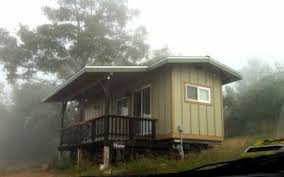
My hermitage ("Hesychia")

Sit in your cell as in paradise. Put the whole world behind you and forget it. Watch your thoughts like a good fisherman watching for fish.The path you must follow is in the Psalms — never leave it.
If you have just come to the monastery, and in spite of your good will you cannot accomplish what you want, take every opportunity you can to sing the Psalms in your heart and to understand them with your mind.
And if your mind wanders as you read, do not give up; hurry back and apply your mind to the words once more.
Realize above all that you are in God's presence, and stand there with the attitude of one who stands before the emperor.
Empty yourself completely and sit waiting, content with the grace of God, like the chick who tastes nothing and eats nothing but what his mother brings him.
It is easy to take this almost literally, here at New Camaldoli, where the view is nearly 180 degrees of ocean, flanked by steep mountains. 
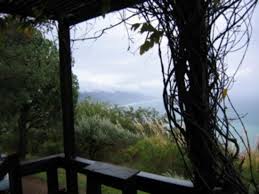
From my hermitage

One is reminded of Italy – an impression encouraged by numerous Italian cypress trees near the church. The silence is profound. As Meister Eckhardt observed, “There is nothing in the world so like God as silence.”  The stars are exceptionally brilliant, because of zero pollution, I suppose,.
Guests are offered self-service meals in the guesthouse, which can be taken to their cells or to nearby picnic tables. The cooking is superb: Italian vegetarian – everything homemade, simple, and fresh.
***************
Today’s prophecy and Gospel were the Creation and the account of our Lord’s healings in Galilee: everyone who touched Him was healed. It is God’s intention to repair the world through Jesus Christ. Lourdes reminds us of the concrete nature of this intention. It reminds us also of Baptism, by which the world is healed. The miraculous spring, which our Lady showed to St. Bernadette, is a type of our Baptism, as the preacher pointed out. He also emphasized the water and the wind of the Genesis story. Water and the Spirit.  To be born from above is to experience the mystical import of these natural necessities (water and air). They are communal we all breathe the same air and drink the same water. IN THIS SENSE, We ARE one another, in our physical nature. Air transfigured is Spirit. Water transfigured is the means of redemption and healing, as at Lourdes.


Obedience, Stability, Conversion – the three are pretty much the same – all references to attention to God.
Obedience = listening
Conversion = “”TURNING-WITH” or turning unto God.
Stability may refer not merely to stating in one physical place (one’s monastic home) but to overcoming the habit of mind that constantly looks forward to the next thing. In other words, stability =  be-here-now

The individual hermitages are given Greek names: Sophia, kairos, &c. Mine is hesychia, which I was able to choose. It was a fortunate choice, not only because of the view, but because of the theme of my self-guided retreat: stillness, which is the meaning of the name. By “accident”, I picked up two books just prior to my little retreat: New Seeds of Contemplation, by Thomas Merton, and The Cloud of Unknowing, in the Paulist Press edition. I found Merton at the Henry Miller Library down the road, and the Cloud here in the monastic bookstore.
On the theme of stillness, the annotation mentions a reference in the Cloud is to the Psalm: Be still and know that I am God. In Latin, the word is vacate. Vacatio = heschia; the emptiness of kenosis, which is the mind of Christ. Emptiness of mind is the aim of The Exercise, taught in the Cloud. So, the whole aim of the contemplative life is to try to go on vacation!
Merton points out that the solitary is never alone for himself, but in company with others. The Cloud insists that whatever progress any contemplative soul may make benefits the whole Church, and reduces the suffering of the soul in purgatory! Contemplation is, in the end, communal, even though all thought of any being other than God is beaten down into the “cloud of forgetting.” Merton goes on to observe that the saint is one who is dazzled by the reflection of God that he sees in everyone around him. Back to Irenæus and the reciprocity between the Life of Man and the Vision of God’s glory.
One might also ask about the proof-texts: “the second is like it” (Love of neighbor and love of God are alike, identical), and John’s observation that one who does not love neighbor cannot love God. Surely this is more than an observation that love of neighbor is a consequence of the love of God and a proof of it. To behold the neighbor, in Ross’s sense, is to love God. Therefore, the Kingdom of God IS among us – in our relationship of love – and not within us, severally, as individuals.
Merton argues that it must be so, because contemplation is granted only to those who do God’s will, and God’s will is that we love one another. So, it is in fact impossible to love God without compassion for all others. Without compassion, we love something other than God.
Merton insists on the distinction – indeed the opposition – between individual and person. (I wonder whether Starets Sophrony ever read Merton. Or maybe this distinction has another source – Heidegger perhaps? Or Kant?  
Friday, 18 January 2013

Sunny LA

After a terrific (but short), overnight visit with Eric and Karine and 3.5-year-old Liam in Montreal, I flew via Toronto to LAX. I checked in to a motel to get a good night's sleep. (I knew for sure I was in LA when, looking for something to read, I found a copy of the Bhagavad Gita in place of Gideon's Bible!).

The next day, my friend, Lev Rukhin, welcomed me to his loft and then left for New York. I am on my own for the weekend. Fine with me: Lever has a great library, wi-fi, and Netflix!

Lev Evgenievich Rukhin & daughter Evgenia Lvovna Rukhina

Lever, a fine cook,  also left directions to Fresh & Easy, his local grocer, which he described as the British version of Trader Joe's. The neighborhood is LA's version of Soho or our warehouse district - lots of converted space for lofts. But still lots of trucks and warehouses. lever's place is a big compound of conversions just for artists. Very cool.

Lever is a photographer:


His signature style is these big murals composed of smaller prints, which he calls "contextual photography." More on his website: check out the Galleries and Portraits menus for more fine pix, including several shot on his motorcycle tour through Russia, after which I met him by accident in 1999. 

We were both dumbfounded when we met at a cafe in Rome and discovered that we had met before in Leningrad! Lever's father, a noted Soviet Russian non-conformist painter, had invited the Yale Russian Chorus to a soiree at his apartment on the riverbank. Zhenia invited me back to meet a few friends the next day. Lever (short for Lev Evgenievich Rukhin) was six months old!

Lever and dad in Leningrad

Martinique, January, 2013


You wouldn't call Ste. Anne a “sleepy beach-front town”. There is nothing sleepy about it, except possibly in the mid-afternoon heat. The rest of the time the dozens of restaurants and tourist boutiques are going strong. And at night there is usually a live band somewhere around the square. It is a thoroughgoing tourist scene, even if most of the tourists are from the same country – France – or Quebec. Everyone speaks French and the euro is the currency, because Martinique is part of France, just like Hawaii is part of the United States.


“The Kingdom of the Banana” (la royaume du banane), and that is about it. There is still some sugar-cane, too – enough to support a dozen or so distilleries – but the Banana is King, for sure. 

The people are mostly poor (50% unemployment), but not miserable, due to the French socialist safety-net. This includes free universal health care and education, subsidized housing, and enough assistance so no one starves. The roads also get a lot of attention, which means work for a lot of people. In general, the Martiniquaises are doing a whole lot better than the Hatiians,  who freed themselves from French colonial control in the 19th Century. Makes you wonder.

You also have to wonder about the Christmas decorations – still on the lampposts, not because they are laid-back, but because, I suppose, the custom is to observe the season right through Epiphany (La Fête des Rois). What is to wonder about is the shimmering, white, electric snowflakes! No one here has ever seen snow. What do you suppose people think when they see them? My favorite seaside restaurant also has a nice little artificial Christmas tree.

Among things not found in Martinique, in addition to snow, are trains, irrigation, cut flowers, and hotels. There are lots of small buses on all the roads; it rains almost every day or night, at least this time of year; there are so many brilliant blossoms growing everywhere wild that I suppose no one bothers to cut flowers that would wilt pretty fast in the heat, anyway. Of course there are tourist accommodations, but none that advertize or make themselves known along the road. I discovered this on my foray to the volcanic North, 
La Pelée vue du Carbet.jpg
Mt. Pelée ~ active volcano
where I intended to find one and stay the night. I didn’t. Even towns marked “H” for hotel on the map kept them well-hidden. I suppose they are mostly resort-style facilities booked through agents or, now, online. Anyway, no motels or Holiday Inns. And no roadsigns inviting customers. Lots of signs for restaurants, but nothing about hotels. Not one. There is a Club Med right across the street from my rented studio, but no high-rise glamour-destinations. This ain’t Cabo or Cancun. I suspect the French have decided to keep it that way – low-key and under everybody-else’s radar. Still, it’s kind of odd. Every little town and suburb in metropolitan France, after all, has plenty of small hotels. I guess people here don’t get in their cars and drive around much, or if they do, they are never more than an hour or so from home. So, no motels.


The cuisine is pretty typically French: steak and fries, grilled chicken and fish, salads at the better places. Their local specialties are mainlyboudin noir (blood pudding), fluffy, light and mild, and acras, 


which are little fritters made of cod or shrimp. They seem to be a staple, sold at all restaurants and also by the side of the road, alongside BBQ brochettes and ribs. Bananas, of course, are to-die-for. I swear I have never had one as good. Could they be tree-ripened?