Friday, 25 January 2008

T or C to PV

Felicitations on the Feast of the Conversion of St. Paul. I am now a couple of weeks behind in this chronicle, but who cares? Though I write from the flesh-pots of Puerto Vallarta, I have a clear recollection of Truth or Consequences. I guess everone knows the story: the old Rdio/TV show offered to originate a broadcast from any town that would change is name. Hot Springs, NM accepted. About 100 miles south of Socorro, T or C is definitely out of the Charming Old New Spain country. It is about as similar to Santa Fe as Chaska. But it has its charm, too. Lots of pastel-plastered buildings ~ mostly motels, it seems ~ trying to catch a ride on the low-rent boom. This is not a high-end tourist destination.

http://www.go-newmexico.com/NM/images/detail/intro-truthorconsequences-gov.jpg

Truth or Consequences, NM

There are lots of people who look like Harry Dean Stanton or extras from a McMurtry film. (The Last Picture Show): scrawny and weather-beaten. Freckled and red-headed. My friends here said that when they emptied the mental hospitals in the ‘70s, many of the patients were sent to T or C. There is a kind of Popeye cartoon ambience to the place.

I don’t mean to make it sound unpleasant. There are LOTS of new fixer-upper motels opening, and plenty of spas advertized. I’m told, howeer, that the only one in which you can actually soak outside is the Riverbend, where I stayed.http://a248.e.akamai.net/f/248/1229/1d/images.world66.com/i_/mo/bi/i_mobile993

The Texas lady with the big blond hair called me “honey” and put me in a nice room for not very much money, including full use of the hot baths. Well,, “nice” is kind. All the rooms are sections of old trailer houses, and they are pretty funky, although clean. One comes here for the hot springs. Luscious hot mineral water overflowing into channels leading to a cascade into the Rio Grande. That’s the othe unique aspect of the Riverbend, it is the only one right on the river. In fact, you can walk down the rock staircase right into the river, if you wish. I didn’t this time, though I have in the past.

My friends here live half the year in MPLS, and they have grown to love this place, and I cn see why. Had a nice long coffee klatch with them before heading off to Tucson.

Not much to report on that trip. There is a place called Hatch, where one leaves the Albuquerque/El Paso freeway tocut off some miles by heading southwest on the state highway. Hatch is in the middle of NM chili-growing country, and I bought a few strings to pass out.

http://www.nmchili.com/images/frontred.jpg

Chilis in Hatch

I had a quiet week in Tucson. Got in touch with my closest friends there, and participated in a Sufi workshop. Then I drove to Berkeley via the back roads. That is, I skipped the coast and drove up through the Mojave desert to Bakersfield.

http://www.cas.vanderbilt.edu/bioimages/biohires/ecoregions/h51308yubr-mke022.jpg

The desert is quite beautiful. Much more desert than the Sonoran, which is lush by comparison. The Mojave looks like the moon, I drove rigiht past Edwards Airforce Base, famous for space program landings. The only excitement was a stop in Laughlin, NV, where I played craps for an hour and a half, I never got ahead very much, and I figured that breaking even was winning. I got to play for that tome after all – for nothing. The parking is even free. I didn’t spend a cent. And in all it was pretty boring.

The image “http://www.laughlinnevadaguide.com/images/hotels/laughlin2.jpg” cannot be displayed, because it contains errors.

Laughlin, NV

Berkeley was fun for the shot time (three days) I was there. My friend Milan, the Slovenian craftsman (interiors) now manages a building in the Castro, where he keeps an apartment for guests like me. It is quite spiffy ~ the first time I have ever spent the night in a modern house in the Bay Area ~ one bedroom with a little balcony, where he cooked a fine steak for me, and a nice basement garage where I left my car. Then I went to bed early so I would be ready when he came to take me to the airport at 3:30. When I return in a couple of weeks, I think I will divide my time between Milan’s and the place in Berkeley.

The flight to Puerto Vallarta connecting in Denver was pleasant – planes half-full both legs, so I could spread out. And a comfortable three hours in Denver to look at the snow and eat breakfast. I slept a lot on both flights. It is just over two hours from Denver to PV, and my old friend, David Kimball was at the airport to meet me. (Old-time Minnesotans will remember his father’s column in the Strib ~ Jim Kimball.) David is now getting ready to retire. His wife, Teresa, is extremely busy with real estate.

Tourism is a big deal in PV. The entire economy is based on tourism, and there is a lot of buying and selling of property. This is a mixed blessing, as David explained, because there is virtually no regulation and he is afraid of the Golden Egg phenomenon. Fifty years ago, Puerto Vallarta was a village of 10,000 living on the edge of a large banana plantation. Then Richard Burton, Elizabeth Taylor, and Ava Gardener made Night of the Iguana here, and now there are million-and counting Vallartistas. The problem is, that if they aren’t careful they could end up like Acapulco. Did you ever wonder, as I have, why you never hear about Acapulco anymore? Well, it’s because they overbuilt so much that the whole place is now like Miami Beach: shoulder-to-shoulder high-rise hotels on the beach. As Yogi Berra would say, “Nobody goes there anymore ~ it’s too crowded.” Not only that, it is not particularly fun, because of crime. The kid behind the counter at my hotel is from there and he says he much prefers PV.

Here, everybody seems to be quite conscious of the side on which their bread is buttered. They are very courteous and genuinely friendly. The traffic stops for pedestrians. They are proud that the streets are safe for tourists at night. They are making a decent living, and they don’t seem oppressed. They don’t want Acapulco’s reputation. But no one has a handle on the sprawl and density problem. Sitting on the terrace of their hillside apartment last night, David and Teresa explained it to me, pointing out the forty-story hotels way across the bay. (We are in the old town, most of the new building is on the north side of the enormous bay.)

Everybody who builds a condo or a hotel has to make it as high as possible, so that more units will fit on the land and each one will be cheaper. If they don’t, the one next door will and be able to sell theirs for less. Since there is no political will to enforce any regulations, the developers just do what they want. Including building condos and apartments in places where they will probably collapse. This is earthquake and mudslide country. David is worried. The Goose that Laid the Golden Egg is in danger of slaughter.

Still, while it lasts, it’s fun. One commentator calls PV the “anything goes blue-collar destination.” It is pretty affordable, although not miraculously so. Prices in restaurants seem to be about what they are in MPLS, which makes them a great deal by San Francisco and New York standards. I had no idea that PV is also “the Castro of Mexico”! But right down the street is a welter of restaurants and night-spots that are, apparently, famous in the gay world. David says the restaurant scene here is exceptional, and from what I have experienced so far he’s right. I had a fabulous veal shank at an Austrian place in a snazzy hotel across the street. Andreas, the owner, came over to say hello to David. It’s named Kaiser Maximillian, which puzzled me until David reminded me of the ill-fated French “Emperor” of Mexico and his Austrian wife. Max died in front of a firing squad after losing to the forces of the great Benito Juarez. Tonight we’re going out for some Red Snapper somewhere.

http://media-cdn.tripadvisor.com/media/photo-s/00/16/41/01/beautiful-puerto-vallarta.jpg

That turned out to be a lovely place right on the malecon or “boardwalk”. The Swede and German who started it ten years ago began by borrowing some plastic tables and chairs form friendly restauranteurs. They had no money at all. Literally. Six months later, they were able to give back the tables and chairs. Now they have a number of restaurants, and they employ hundreds of people. They rode the wave of development, and it’s kind of nice to hear about. It is hard to argue with all the jobs created, and all the good-looking young people making their way out of poverty. But I sound like a capitalist! At some level, the whole thing may turn out to be a ponzi scheme, I suppose.

Lunch with David, again on the beach. This time at one of the oldest local restaurants, Las Palapas. It dates back to the pre Night of the Iguana days. As you msay know, a palapa is a roof made out of leaves, mostly for shade. The restaurant started out as a palapa over a concrete slab next to the sand. It is pretty much that still, only glorified. It is an extremely pleasant way to spend an afternoon.

Then in the evening, I walked down into the old town for dinner by myself. I found an asaderia with a three-piece band (guitar, drum, and old-fashioned, wooden-block marimba of liquid tone). Here the price was definitiely right: $11.50 for all-you-can-eat barbecue including a half chicken, fajita steak strips, chorizo, BBQ ribs accompanied by a roasted young green onion, homemade tortillas, hot roasted peppers, “cowboy” style beans, and three sauces (red, green, and pico de gallo), and preceded by chips and two lovely little quesadillas with interesting fillings. I don’t think I could find that in Minneapolis.

I have a feeling that this part of the blog is going to be mostly about eating, although David promises some excursions into the back country this weekend.

Tuesday, 22 January 2008

Ojo Caliente

The first European to visit Ojo Caliente was Alvar Núñez Cabeza de Vaca, about whom you can see a good eponymous movie.

Retrato deÁlvar Nuñez Cabeza de Vaca
Retrato de
Álvar Nuñez Cabeza de Vaca

Shipwrecked in 1527 somewhere in Florida, he and his African slave walked (!) to Mexico City. On the way he made a detailed and meticulous reord of what he saw. This included many Indian cultures that would be wiped out by European diseases. Estimates vary, but as many as 60,000,000 may have perished by the middle of the 16th Century. This was already underway when Cabeza de Vaca came through, and he did note deserted towns. Why on earth he went to the upper Rio Grande I don’t know, but he named the place Ojo Caliente, which I think is a pretty general term for hot springs (it means “hot eye”). Anyway, he described the salutary mud-baths that the Indians loved, which are still available at the big spa.

My reservation was lost, but I was able to stay a half mile away at a cheaper and more commodious B & B, where I was the only guest. They even gave me a discount for letting the breakfast cook have a vacation. And the main spa’s management gave me free use of the facilities for two days, including extras I would not have purchased, which amounted to about $75 worth of free services. On night one, they gave me a private, outdoor, arsenic pool, complete with Kiva fireplace. (For some reason, the arsenic in the water is thought to be good for you – they also have pools heavy in iron and others in sodium.) With the piñon logs crackling, I looked at the stars some more, then went to the hottest pool to finish up. They also have a sauna and steam-room and Swedish wrap, also complimentary, which I accepted the following day. The old hotel where I would have stayed is on the historic treasures list, which may have something to do with its lack of private bathrooms (they figure you can bathe in the pools, and the toilet is down the hall). There is a very creditable restaurant, however, not too pricey and very friendly. The whole thing was built by that congressman guy. Hotel much as it was a hundred years ago, I suppose. The rest of the spa is, of course, much more up-to-date, and getting more so.

Out on the road in Ojo Caliente is a superb little café, the southerly of two, called Café Taquita, as I recall. If you ever find yourself passing through, give it a shot. Real northern New Mexico home cooking. Home-grown chilis and genuine sopapillas (fresh fry-bread),

served by Spanish ladies of winning temperament.

On south through Santa Fe and past Albuquerque to lodging in the quiet and aptly-named town of Socorro. What a lovely state!

Friday, 18 January 2008

Taos the Ancient and an Old Friend

South of Colorado Springs and all of its bad vibes (Air Force Academy with its hazing and right-wing religion, “Focus on the Family”, and those American Taliban, the Christian Reconstructionists) the atmosphere changes for the better. The next town is Pueblo, then Trinidad. Between these two refreshingly Hispanic names is Walsenberg, not so atmospheric, but this is where I leave the freeway and go west across La Veta Pass into the San Luis Valley. (From here on, as you see, nothing but evocative names.) The little town of San Luis isn’t much. It is part of a cluster of tiny settlements (San Pedro, San Pablo, San Francisco) that are the northernmost extent of Spanish colonial settlement north of Santa Fe ~ all of them older than anything in California. For now I have crossed the sub-continental divide that was the rough border between French Louisiana and New Spain, leaving the Mississippi watershed for the Rio Grande.

The great San Luis Valley runs for about a hundred miles north and south, lying between the San Juan mountains on the West and the Sangre de Cristo range on the east. It is said that this is the inspiration for the phrase in America the Beautiful, "...for purple mountains' majesty above the fruited plains..."The valley floor is almost 7,000 feet above sea level. Last weekend, when I was in Boulder, the temperature was twenty below in Alamosa, the valley’s main town. Taos is at the south end of the valley. And in the middle is Colorado's fourth highest mountain, Peña Blanca (Blanca Peak), which everybody just calls Blanca. She is my favorite mountain, my candidate for the American holy mountain.

http://z.about.com/d/forestry/1/0/a/B/blanc1.jpg

Blanca

Because there is something about Blanca’s majesty that is almost sinister. Although I have seen her many times, I have never seen her peak; she is usually shrouded in a cloud. In the summer it shrinks to a kind of celebratory banner, trailing from the peak, but it is still there. She is always white, hence the name, and in the winter, her glaciers extend down to meet the snow on the valley floor. Topping 14,000 feet, she seems all alone, even though her range extends north and south on either side, Under her one-hopes-benign shadow, I turn south at Ft. Garland and a few miles later I am in "the land of enchantment" itself, New Mexico.

Questa, Lama, Arroyo Hondo ~ more evocations of distant past and personal memory. In Questa I bought for my mother a turquoise and silver bracelet, made by a part Menominee Indian, whom I had first met at New Buffalo commune in Arroyo Hondo.


http://americanhistory.si.edu/lisalaw/images/G04M.jpg

Building New Buffalo Commune

New Buffalo was the location of the hot springs scene in Easy Rider, and Pepe lived there when I stopped by on my third bus trip (old school bus converted to a hippie RV). On my SECOND bus trip to Taos, we got stuck in the mud going up to the Lama Foundation, one of the famous centers of hippie/newage spiriutality. Murshid Sam Lewis is buried there (“Sufi Sam” of 60s San Francisco, the model for R. Crumb’s Mr. Natural).


The image “http://www.yoga.com/Studios/images/sites/2103.2.250.SufiSamLewis.jpg” cannot be displayed, because it contains errors.Sufi Sam

And then Taos itself. I stay in an adobe motel across the street from the pricier Kachina Lodge. My place has a “Kiva fireplace”, one of those adobe semi-circular corner affairs and an outdoor hot-tub.

The image “http://z.about.com/d/architecture/1/7/g/O/fireplace-030209.jpg” cannot be displayed, because it contains errors."Kiva" fireplace

I brave the ten-degree weather to soak in it and to contemplate the strange lights in the sky, which I am told, are called “stars”. There seem to be a great many of them at this altitude. Milky Way clearly visible. Thus soaking (with the plastic tub-covering pulled up to my chin to save warmth), I reflect ~ as is appropriate for New Year’s Eve ~ on the past. Taos’s past and my own.

On my FIRST trip here in the hippie bus, we risked death by climbing up the dirt switch-back out of Arroyo Hondo to a commune on the high plain (llano) called Morning Star.

http://laurelrose.com/MORN/pueb1.jpg

Pueblo at Morning Star, 1971

The building was a row of adjoining adobe huts, which they called their pueblo. This was one of sixty-some communes in Taos County. We visited for the afternoon, and then made our way in a snowstorm to Santa Fe, where the communards we brought with us had an outpost where we could crash. The sixty-mile journey took us six hours, because the roads were extremely treacherous and the old exhaust-manifold-vacuum- driven windshield wiper was not up to the thick, wet snow. We had to stop every ten minutes to clear the windshield. We took two of the communards with us all the way to San Diego.

David and Penny Pratt told us about life as hippies in the environs of Taos. They explained that if they were ever walking up the road and saw a car coming, they would dive into the ditch, because it was just as likely that a Spaniard would swerve at them, or even shoot! Many of the hippies carried guns to defend themselves. The inhospitable natives were not to be called Mexicans. They had been here since long before there was a Mexico. The first Spanish families settled here in the 16th Century. Before even the Calvinist theocrats set foot in Massachusetts. But early as they were, these Spanish were immigrants too, of course.

http://www.vacations-land.com/blog/wp-content/taos.jpg

Taos Pueblo

To the Pueblo Indians (a very generic name, they are more properly known by the name of their respective pueblos) the Spanish are newcomers pretty much the same as the hippies, and they keep to themselves. It is virtually impossible to get into one of their Kivas for a ceremony.

http://photo.net/photo/pcd0087/great-kiva-kids-12.4.jpg

Kiva open to public

The Pratts observed that this country was overlaid with stratum after stratum of history and prehistory, from the Anasazi ancstors of the Taos Pueblo to the Aztecs who are rumored to have ranged this far and to have left a cache somewhere on Blanca, to the Athabascan nation we call Apaches, whose Jicarilla tribe is settled on a reservation not far to the northwest, to the Conquistadores and the Padres and the Spanish settlers (including Maranos ~ crypto-Jews fleeing the Inquisition), to the Penitentes, who arose in the vacuum of episcopal oversight. The diocesan See was Durango, almost five hundred miles to the south. Then came the Mexican Revolution and the Pueblo Revolt and the 1848 war, and suddenly Taos was in the United States. New settlers arrived over the Santa Fe trail from Missouri, including the first archbishop of Santa Fe, the French-born Jean Lamy, who was sent from Cincinnati in the 1850s. (Willa Cather’s Death Comes to the Archbishop). Lamy had to deal with Penitentes and their secret Moradas cult, with unofficially married clergy, and with a laity that, though Spanish, was pretty much pagan.

The image “http://southwest.library.arizona.edu/spmc/fig60.jpg” cannot be displayed, because it contains errors.
Penitente Morada, Taos


Then came the Texas cattle people, who made Albuquerque their center. But still the Santa Fe-based Spanish were sufficiently strong to remain a political force to be reckoned with. In the late 19th Century, for ten years the territorial congressman was from Ojo Caliente, across the river from Taos. Though an Anglo, he was not a Texan, having been sent back to his parents’ home-town of St. Louis to be educated. A bit later came Georgia O’Keefe and D.H. Lawrence, and finally none other than C.G. Jung. The latter got one of the Taos Pueblo Kiva guys to talk.

http://www.conspiracy-times.com/images/sub_images/cg_jung.jpgC.G. Jung

You can read about it in a remarkable essay in Memoriues, Dreams, and Reflections. Something about consciousness at the top of the world, which is where you are if you are in Taos, from the Pueblo point of view. And REALLY finally, come the hippies, refugees from the flesh-pots of California, following Jung in search of the mystical enchantment that is palpable here.

Well, the hippies weren’t really the last newcomers. Now there is urban sprawl at the Top of the World, including, I am sorry to report, Walmart and plenty of fast-food. The old Plaza is pretty chic. Must be like Santa Fe was 50 years ago. All artisanal shops and galleries. Think Stillwater in adobe. Nevertheless, I am happy to report, the magic is still here.

Part of the magic for me was my visit to my old friend, Gendron Jensen, who lives with his wife, Christine,

http://www.horseflyonline.com/images/articles/Jensen&TaylorP.jpg

in a fabulous Japanese-style house about twenty minutes up in the mountains behind Taos. I got stuck in the driveway, naturally, but his kindly neighbor (a Spaniard who is in charge of security at nearby Los Alamos) pulled me out with his winch and a couple of fat-tire ATVs. The Rio del Pueblo valley (tributary of the Rio Grande) is a lovely, remote spot. Around one corner I spooked a big bull elk (or are they stags?). What a magnificent creature!

The Jensens are both successful artists, with shows in their résumés in all the big cities and in Europe. Still, they have to watch their pennies and it’s a never-ending hustle. They both are artists of the pen, drawing beautiful creations, she abstract, he of bones. (His sobriquet is the Boneman.)

http://www.bellmuseum.org/drawntonature/auction_art/Jensen,%20Gendron%20-%20insculpta%20est.jpg

Bell Mueum

I met Gendron through the late Fr. Paul Berg, whom we remembered at length during my visit. Paul was an Episcopal priest at Grand Rapids when I met him. He was a central figure in a remarkable revival of interest in an abandoned Russian church in the muskeg north of the iron range, in a place called Bramble. Paul is buried in the orthodox graveyard there. (Another story.)

G. gave me Paul’s pectoral cross, which I will wear habitually now. Paul was a man of very special and unique holiness. Wherever he was, he attracted people of unusual creativity, like Gendron, and his friends included a wide array of artists and poets. Gendron calls him Paulus Dei and we decided that we must write about him at length. Here I will just say that Paul inhabited the liminal reaches of the church and society. He was counter-cultural in the best possible sense, and a huge influence on anyone who knew him. That G. thinks me worthy of his cross is an honor of which I am not sure what to make. G. and I learned from Paul of the charming Russian iconographic motif, Our Lady of the Unexpected Joy. G.’s gift was certainly that for me. But I have a feeling that it is a sacramental sign of something else.

Here in the mountains, whose underlying rock is a deep blood-red, named for the Eucharistic Mystery, I find myself confronted with opening possibilities. G. and I have already agreed to travel to San Salvador next winter to visit his old friend, who was St. Oscar’s private secretary.

Monday, 14 January 2008

Memories of Muriel

A tough old broad named Muriel Baughan first told me about Taos. Muriel managed the games at the amusement park, where I had my first summer job.

Artist's Recreation of The Cyclone Rollercoaster at the Excelsior Amusement Park

Not quite on its last legs then, the park was a vestige of the glory days at Lake Minnetonka, when there were dozens of resort hotels, serviced by Streetcar Boats, and the great interurban streetcars themselves, which brought crowds to Excelsior from Lake and Hennepin in twenty minutes (a time not possible now, except by helicopter).

I grew up across St. Alban’s Bay from the park, which was lit at night by incandescent lights, strung all over the outline of the roller coaster and the other rides and buildings. With the windows open in the summer, I would go to sleep to the sound of the rattling coaster cars and the shrieks of the passengers. A visit to the amusement park was a high adventure in my childhood, and it was really exciting to g a job there at the age of thirteen.

The law forbade children to work after dark, so I usually worked from (10:00 am) to 5:00 or 6:00 pm. The work wasn’t very hard, just standing behind the counter taking the dimes and quarters from people who threw baseballs at wooden milk bottles or tried their luck at skee-ball. Then there was the fairly creepy “Walking Charlie” in which life-sized dummies of seedy-looking bums paraded across the back of the stall and people tried to knock their hats off with baseballs. The only difficult part was bending over all day to pick up the hats or the milk-bottles. Mostly it was boring, sitting on an orange crate all day, waiting for customers, who rarely came during the day on weekdays. The pay was 75¢ an hour, the minimum wage “for women and children in the entertainment industry."

Muriel liked me because I didn’t rip off the till, like the older boys, muscled and motorcycled, from nearby farm towns, who sometimes worked for her when they couldn’t get a more lucrative position running the rides. They had cut-off denim jackets over their tight T-shirts and thy smoked Camels and they ripped Muriel off. This was not a good idea, because Muriel, an experienced carney, was way tougher than any of them. Even though she was dumpy and short and fat, and wore a man’s shirt outside her slacks, and had a few missing teeth and a couple of gold ones that showed, she had a fierce temper and you didn’t want her mad at you. I never gave her cause, and I brought a number of my more-or-less nerdy friends to work there then next year. They were honest too, and as I reflect, it may be that we opened a whole new world to Muriel.

During the months the park was open (May to September), Muriel lived with her “cousin” Edna, who whirled the candy floss, in an old resort, long since let to long-term renters. They may have had some carney gigs elsewhere in the South, but mainly she and Edna just drove around the Southwest in her ancient, war-time Dodge sedan. She particularly liked northern New Mexico.

Muriel would stop by to chat every day. Just to check in as the boss, but sometimes she would talk a little more. She told m about cowboys and Penitentes, and about the great Taos Pueblo. She showed me pictures, and she even had some Indian-made turquoise and silver jewelry. I learned about the mysterious muradas, the windowless houses where the Penitente societies had their ceremonies. And she told me the lurid stories of the Holy Week excesses, in which people not only flagellated each other, but actually crucified someone. Every year.

I didn’t know whether to believe it or not. Was Muriel making this up? She was a sincerely devout Catholic, and I had been raised to know that Catholics were pretty exotic. But real crucifixion? Muriel made Taos sound like a foreign country. I later found out that it was all true, and Northern New Mexico has always been a genuine “land of enchantment” to me. I wanted to see whether the charm was still potent, so I arranged to spend some time in the Taos area. My old friend Gendron Jenson, a successful artist from Grand Rapids, called me last Fall, and I promised a visit. Boy, am I glad I did. More on that below.

***

The Excelsior Amusement Park closed sometime in the late '60s, I think. The last thing to go was a beautiful old dance hall, called The Pavillion, across the street from the main entrance to the park. It was a domed ellipse, all made of wood, with a large dance floor in the middle, circled by an arcade with booths for resting and conversation. I always thought it a shame that they didn't preserve at least that fine old structure. It went out with in glory, though. The last band to play there was the Rolling Stones.

Thursday, 27 December 2007

Hello Friends!

I thought I would keep a kind of electronic journal again this year ~ even though I will not have places nearly as interesting as last year's to describe. This will be more "today I drove from a to b", for those who are curious.

So the highways have been clear and dry. There is almost no snow left on the plains, but I did wake to a beautiful frozen-fog effect on the trees. Today I drove across Nebraska ~ from Council Bluffs IA to North Platte. I stayed my first night out on the banks of the Missouri. Well, not really. Harrah's is on the bank. It is technically a "river boar" so they have full Las Vegas gambling, complete with garish lights and a twenty-story hotel (some riverboat).

I made a point of staying in Council Bluffs, because it is a very early childhood memory, from one of the winters before Kindergarten, when my grandmother stayed with us to take care of me. I remember her referring to what sounded to me like "Consa-bluss". It was the Big City for her when she was growing up in the 1880s about fifty miles to the NE in a town called Harlan. It is not too far from Early, for you Greg Brown fans.

Anyway, I think both are very evocative names. We have a number of them, I was thinking: Blue Earth, Sleepy Eye, Good Thunder.

The land is beautiful even in winter. If I remember correctly, last year I compared Piccardy to Iowa. I was right, but it's really more like Nebraska at least the Platte River Valley where I-80 runs. Completely flat, with little groves dotting the horizon, and lots of wetlands all along the river. Just like the Somme. No gothic cathedrals in N. Platte, however, as far as I know.

There is an Episcopal Church, though. And the Baptists barely outnumber the Lutherans. My intelligence is drawn from the Ramada Inn's list of churches. There is one called,
suspiciously, "Church of Jesus Christ" which I'll bet has deliberately left off the "LDS". There are also two entries for "Church of Christ", one distinguished by the perplexing qualification, "Vocal." Do you suppose the other one is manual only? Or nasal? Maybe they are mute. anyway, it almost makes me wish I were going to be here on Sunday so I could check out this "Church of Christ (Vocal)." Or maybe the non-vocal one would be more interesting.

So, tomorrow I drive away to the Mountain Time Zone (I am surprised that it is still Central, here in N. Platte) and the unbearably hip town of Boulder. My old friend
there, Joe de Raismes (a real, live, French viscount) is a Sufi of many years, whose Pir required them to become Muslims. They have a little community, all of whom I have known for a long time. They never would let me attend any of their meetings, though (they are kind of like Wisconsin Synod Lutherans, as far as that's concerned). But either they have mellowed or they think my contact with Pir Vilayat has koshered me, so to speak, because they have invited me to their initiates-only Khanega tomorrow night.

That should be fun. Years ago,
I introduced Joe to another old friend, a Minnesota woman. In 1966, Annie and I drove to Acapulco in my Morgan. She looked like a cross between Melina Mecouri and Julie Christi. http://www.dolcedolce.com/ns_jan242007/gracey_small.jpg http://homepage.mac.com/jdalisay/blog/PenmanMar07.htmlThen she moved to the mountains and married a Mountain Man. The last time I saw her, she was living with him in an miner's abandoned log cabin on the back of Aspen Mountain, where you had to climb up on skis. But that's another story.

A Salaam Aleikum*,
Bill+


* Did you know you can be jailed
in Pakistan for saying this if you're not a Muslim? Then in Tajikistan, it is the standard greeting for everybody. You want to be careful, I guess.

Sunday, 18 February 2007

Piccardy and Notre Dame d'Amiens


After a couple of weeks of driving around Paris, I am really getting to feel comfortable here. It was still pretty overcast and rainy the day my friend Cindi was supposed to arrive from MN. It was even worse in Chicago, where the blizzard was so bad that she missed the Air France connection. Not knowing it, I REALLY got to know the Charles de Gaulle Airport and its several terminals (the AF flight was late, and gated at a terminal different from the scheduled one, so I parked and waited at both until it became clear that something was wrong). Anyway, C. couldn't get on another flight for Paris until it would have been just about time to come home, so after two days at the Holiday Inn in Chicago, she went home. Too bad.

The next day was beautiful here - the first of a series of what really feels like early Spring (crocuses up, and all - even one , lone cherry tree in full bloom down in the Bois de Boulogne). I had been feeling guilty about not taking enough advantage of the city, while I'm here, so I drove to the Musee Guimet (which I have to brag about finding without consulting the map - and on the way found a spectacuklar view of the Eiffel Tower, framed by a beautiful street, Avenue Victor Hugo). This is the Archaeological museum, where Claude's sister, Marielle works (except she's in Laos now). There is a unique exhibition of treasures from Afghanistan, but the line was out the door and down the steps and around the corner, so I decided not to do that. Instead, I just drove around: up the right bank of the Seine (not the underground tunnel expressway, but the quaiside streets past Concorde, the Tuileries park, the Louvre, the Isle de la Cite and Isle St. Louis all the way to Bercy (the Frank Gehry building commissioned as an American center, which then went belly up [the center, not the building] and now houses the Cinematheque Francaise, the museum of hte history of cinema where you can watch lots of classic movies every day - the French invented movies: a couple of brothers aptly named Lumieres, in the 1880s), then back to the eastern arondissments to the famous cemetery, Pere Lachaise. I found out that this part of Paris is delightfully hilly, and it was fun to see a new part of town. Except for the cemetery, tourists don't come here much. Also, it is not particularly trendy. I was strongly reminded of my first visit to Paris 44 years ago.

It occured to me that I don't have to feel guilty about not going to the Louvre or something every day. I'm not a tourist. I am just living here for a while. But then this past weekend, I started some serious sightseeing. On Saturday, I drove to Amiens, the principal city of Piccardy. For those of you to whom Piccardy means a major rather than a minor third at the end of a tune, it's one of the old royal provinces of France, and it is home to several important medieval cathedrals. But none more important than Amiens. It is pretty much my favorite. It doesn't have Chartres' glass, the glass is all clear - grisailles, which is just as well I think because it is so fabulously light inside, and the architectural features are perfect. It is the highest cathedral in France. The highest complete one, that is. Neighboring Beauvais, to the south, is higher, but it just has a choir, because when they started to build the nave, it fell down and they gave up!

Notre Dame d'Amiens was built in an unusually short period of time (16 years), and the unity of the Master Builder's conception is apparent. There is no trace of Romanesque influence or moorish flavors. It is possibly the best example of the pure gothic style. (Be sure to click on the pictures to enlarge them - some of them came out quite well, and you can see lots of detail.)


Its facade also has breathtaking statuary - nothing ever lost. Every niche of every archivolt is ocuupied. (See pictures at Wikipedia) The north portal has one row of saints that depicts two martyrs, one in chasuble and the other in toga, both holding their own severed heads! (Enlarge and check out this one especially, the decapitee in the toga is flanked by a very pleasant, thurificious angel.)

Near the crossing is a large labyrinth, very clearly marked in black and white tiles. It was explained that those who couldn't make the


pilgrimage all the way to Jerusalem or even to Santiago de Compostela, were encouraged to gain spiritual benefit by walking the labyrinth, the center of which represents (I think) Jerusalem. I noticed that the cross in the center's tiling is not oriented with the cathedral itself (which is on an east/west axis, as usual). Maybe the cross is pointed toward Jerusalem or something?

But most glorious is the nave, soaring more than 136 feet. The great nave windows are in the clerestory, atop the blind arcade of the treforium. Seven bays in the nave. The choir

and apse are actually wider than the nave, because the ambulatory leads around a series of apsidal chapels radiating out, each more gorgeous than the last. All of it is a kind of golden white color. Indescribable. UNESCO has registered it as a patrimonial treasure of the human race. I actually wept.


The choir is adorned by a later treasure: carved wooden stalls of the 15th Century. intricate and delicate in detail.

The edifice sits on the high bank above the Somme. [Not far away was the dreadful battle: Somme. The whole history of the world cannot contain a more ghastly word. (Friedrich Steinbrecher). More than a million casualties. A MILLION in one battle, in 1916. It is also noted as the debut of the tank - a British invention] The river flows more or less east-to-west at this point, and only about ten miles to the east is Corbie, the site of the great Abbey that was home to my Parish's patron, St. Anskar. He was born in Amiens, raised at the Abbey in Corbie, and volunteered to be a missionary to the pagans up north. First Archbishop of Bremen and Hamburg, and first missionary to Scandinavia. He is known to history as the Apostle of the North. Not much is left of his old Abbey on the Somme. Just a much later church, a very large late gothic structure - can't be much older than 15th C. - with plenty of baroque features. It is closed except for occasional services, so I didn't get in. I did ask St. Anskar if he had ever dreamed a guy from Minnesota would come looking for him 1200 years later!

Corbie is a pleasant, laid back town. I saw several like it as I deliberately avoided the freeway for a while. It reminded me of home. Not the architecture, naturally (Piccardy is kind of like Belgium - mostly brick row-houses that aren't all that charming), but the feeling. This is very rich farming country - like southern MN or IA - it was already pretty green (winter wheat.


Mostly flat, with low, forested ridges in the distance, and the occasional ravine or river valley, which made me think of Trempealeau County or the land around Menominee. Think driving from St. Paul to Eau Claire, that's Piccardy. Quite pleasant, but nothing very spectacular - except for those ravines.

The Somme Valley itself is extremely marshy. It's not just a river channel, but a whole lot of backwaters and little ponds and lakes. I drove through this countryside and noticed that there were quite a few houses that looked like humble little vacation homes. This is not a part of France that is mobbed with tourists, ever. And these summer houses were barely more than cabins and trailers. Kind of nice, actually, compared to the swanky and expensive villas in tonier places like Brittany and the South. And the fact is, the Somme Valley is quite wild. No one lives in these marshes except waterfowl, and they are really quite pretty. It made me glad, despite the horrors associated with its name.

And today (Sunday) I managed to get to St. Sulpice in time for the organ audition (recital). Later, I had another driving adventure, to attend a free afternoon concert of 17th C. music on the backside (north) of Montmartre (18th Arr.) This is the seedier part of Paris, and quite fun to drive in. I say that because I got lucky. I consulted the map all the way, but was headed for the wrong section of the street, an error that I caught just in time. I overshot the mark and was about to bail, when I noticed a brasserie named for my street, and so I looked, and sure enough, there it was. I went around the block, checked the numbers, and - by God - I found a PARKING PLACE RIGHT BESIDE THE VENUE, which turned out to be a Protestant church center.

The concert, however (which started one minute after I arrived), was all RC tenebrae music from the 17th and 18th Centuries: Stabat Mater by an Italian named Sances, and Lamentations lessons by Lalande and Couperin, alternating with instrumentals by Frescobaldi, Couperin, and Barriere. A very good soprano, accompanied by a baroque cello and clavecin (is that what we call a clavichord?). And it was FREE. (Donations accepted.)

Good way to get ready for Lent.

Wednesday, 7 February 2007

Brittany

The medieval lavoir and mill-race at Vannes


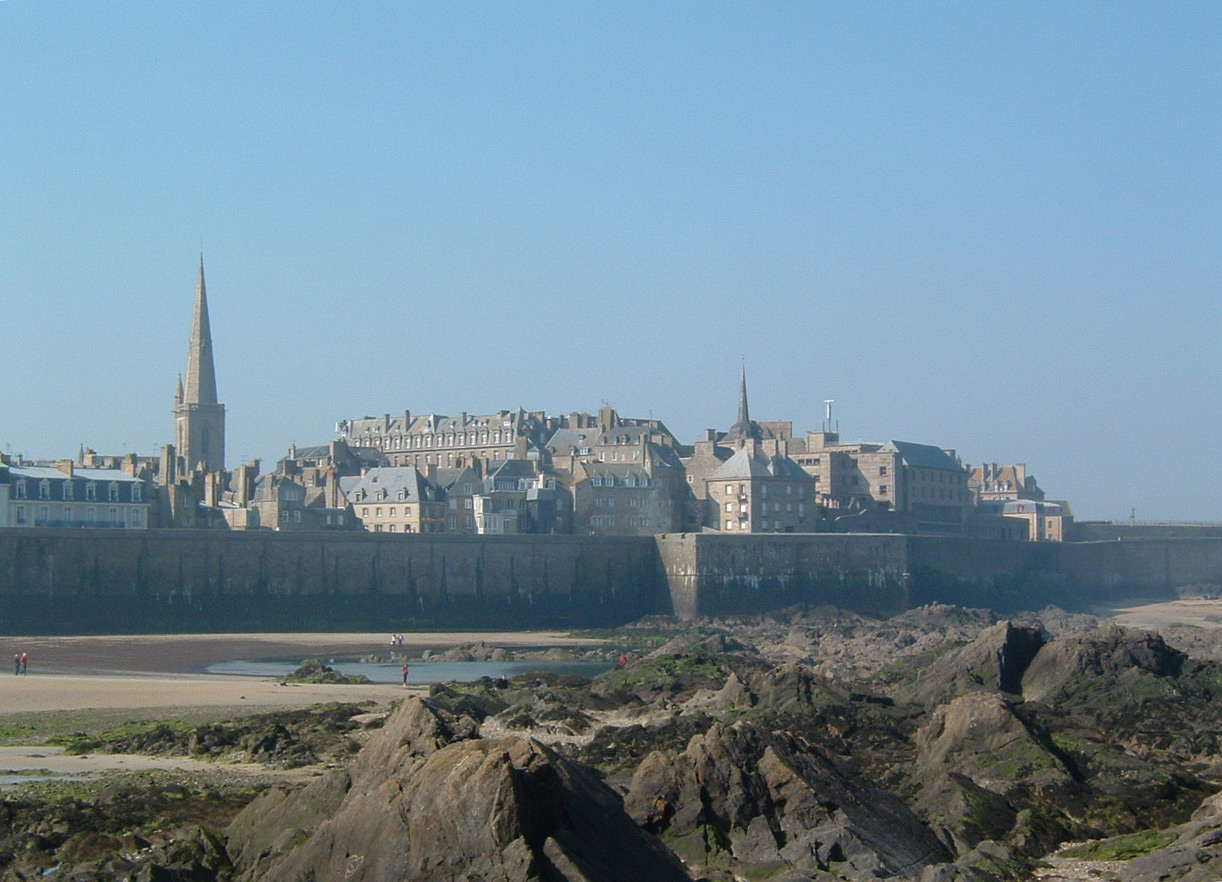
Cancale looks SE across the bay towards Mont St. Michel. Just west along the coast is the 17th Century fortified port of St.Malo . :
Very beautiful, although it had to be completely rebuilt after WWII, inside and out. This was an important base for the French Navy in its interminable struggle with the English. St. Malo was the home of the Corsairs (privateers, licensed by the King to do whatever they wanted to the English on the high seas). For some reason, they let you drive in this completely walled city, wqhich has only one gate open to the land. As you can see, it's kind of a nightmare. (The picture is more visible if you click on it.)

We continued west on the coast [you can manipulate this map to see all the detail you wish] past St. Brieuc to Perros-Guirec, which is about the northernmost point in Brittany. Here everything is made out of that striking rosy granite. Seawalls, churches, houses. Then on to Brest, which is the headquarters of the French Atlantic fleet. Poor Brest was really completely destroyed during the war, for obvious strategic reasons. So now, except for the old fort, all the buildings are ugly and hastily-built, in the functional post-war modern style devoid of charm, which reminded me of the Soviet Union. Too bad, because the setting is spectacular: in a deep estuarial bay, with lots of islands, points, and inlets. A perfect harbor.

We spent the night across this big bay, on the southern shore of another peninsula, named for the charming little town of Crozon. [See map.] Here I think I had a feeling for Bretagne profonde. The people were wildly friendly - like the Irish. Everybody smiles and goes out of their way for you. One hotel (42 euros), one restaurant - 39 euros for local lobster. (That’s over $50, so I skipped it. I also skipped the $12 breakfast at the hotel.) We ate dinner and breakfast at the pub next door. And it really was more like an Irish pub than a French café: big exposed timbers for rafters, a crowd of guys watching soccer, and very friendly. The bartender gave us a big smile and offered his hand in greeting. I ate a croque madame andouillette. Now, a croque monsieur is a grilled ham and cheese sandwich, but this was made of andouille sausage instead, which is not like Cajun andouille, but made of tripe (or "bowels", as J-l explained). When served as a croque madame, it comes with a raw egg, which I put inside, where it seemed to cook a little. Anyway, with mustard it was just fine. Crozon has a market on its square every day of the week. Loads of fresh fish from the night before.

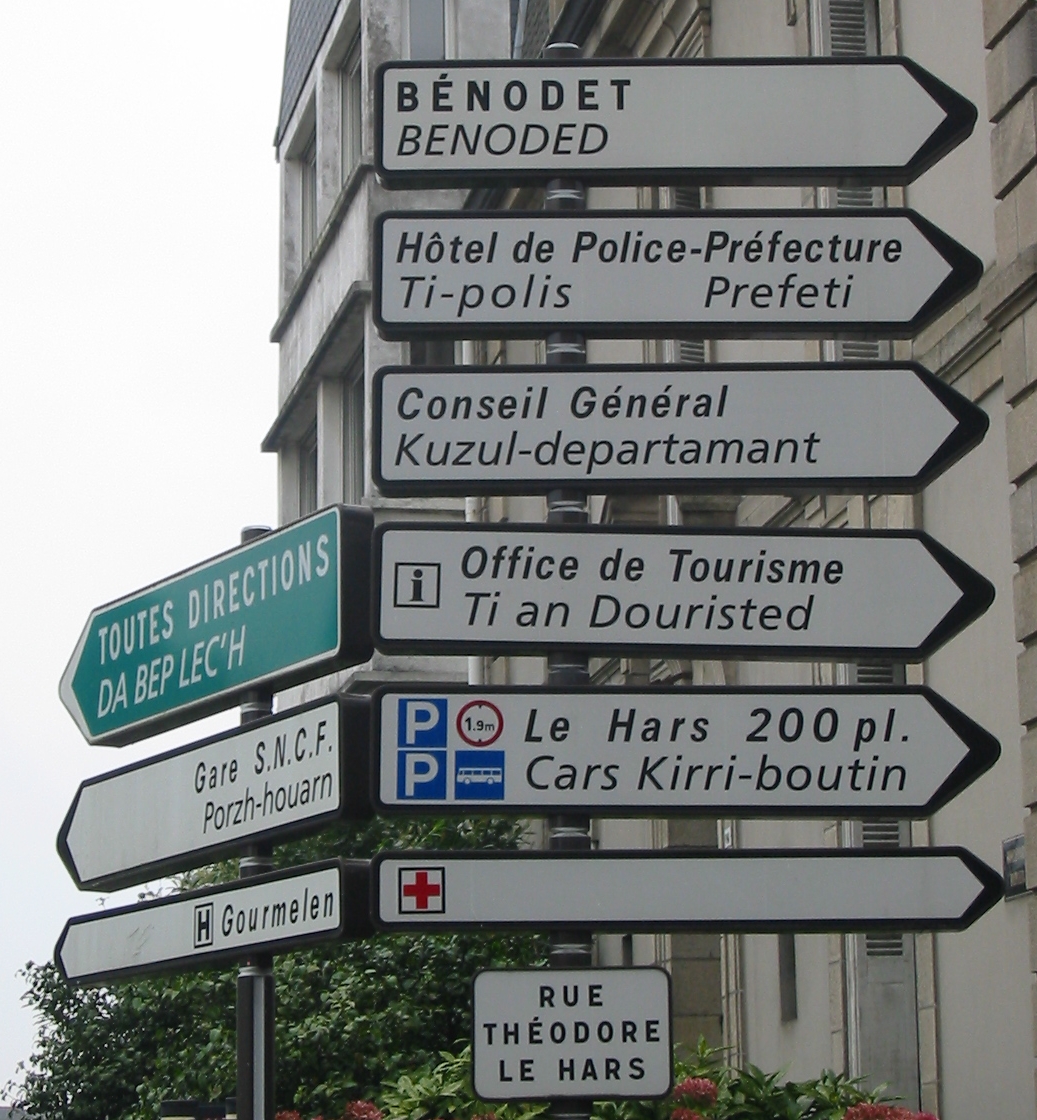
Speaking of authentic Brittany, all the road signs out here are in two languages (as they are in Provence and around Perpignan - the Catalan part of France right next to northeastern Spain). It turns out that there is more than one Breton language. As in Wales, it is taught again in schools. It looks really odd in French orthography. Most of these signs are Kerthis and Kerthat, which I guess refers to clans. Ker = Mac in Scotland.

J-l says there is a fairly strong nationalist movement here. They want their language and they are very conservative ("fascist" is J-l’s term) about religion and politics. This is the only part of secularist France in which religion is taught in the public schools. Because, according to J-l, who is a teacher and sometime union official, otherwise the public schools would be empty.

After coffee and croissants at the café, we drove around the next bay to another charming fishing town called Douanenez. They also can the catch, so their economy is thriving.

We headed south for Quimper, a small city in a deep valley, with another to-die-for cathedral (St. Coretin). This one is distinguished by its lightness.

The stone is bright, the ribs are painted a delicate yellow, and there is just a general sense of airiness and space. They have also done very well in incorporating modern elements into the gothic. The altar in the transept is a beautiful big marble table, which I think harmonizes with the gothic feel better than all of those baroque reredoses you usually find. Likewise, the new organ. It is housed in a cylindrical tower of gleaming metal. Per the town’s official website:

Thanks to recent restoration works of the interior polychromes and
ribbed ceilings in yellow and ochre and the white washing of the facings, the
cathedral is a true revelation of 15th century architecture. This colourful
restoration was totally in the spirit of the first builders, in opposition to the austere look of religious monuments during the 19th century.

Another feature of this part of Brittany is the pastel and brightly-painted houses. You don't see this in Normandy, or on the north coast of Brittany either. The paint-jobs are almost like Mexico. Lots of images of Quimper here, just stay with it a while, because the images change rapidly.

Those of you familiar with Asterix and his companions will remember Obelix, the menhir (megalith) delivery-man. Well, we found where he delivered them: outside Carnac there are fields and fields of these standing stones, three to four feet high, arranged in rows, as in a modern cemetery. [More on these and some exceptionally good pictures.]

After a quick visit to Vannes, once the capital of the Kingdom of Brittany, (see lavoir at top) which lasted for about three generations just after Charlemagne and then became a Duchy, we headed home, a three-hour drive on the autoroute.