Tuesday, 4 February 2014

Hula


Among many bad things done by the American missionaries was the banning of Hula. I suppose it was because of its pagan connotations, praising gods and telling epics and legends. Maybe also because the women were topless, except for leis, and the swaying hips were thought lascivious by the puritanical Yankees. Anyway, I remember the latter idea from my youth, when people would wink and scoff at the notion that “it’s all in the hands.” The idea that there was something venereal about Hula probably persisted in the minds of the young sailors, who saw it when it was revived.
But it is anything but an erotic dance. The local parish Hula troupe danced at Mass last Sunday. It was really uplifting, the story enacted was our Lord’s encounter with the rich young man. Every gesture of hand and foot and hip has a sign-language meaning, interpreting the words of the song that is being sung (in this case a record). It is hard to convey how gentle, beautiful, and gracious it is. A great many hymns and Biblical passages are now choreographed this way.


The Parish Hula group is exclusively Kapuna (seniors over 60). Both sexes.The eldest is a lovely Japanese lady of 85. All of them sway like palm-trees in the breeze and make the complicated, flowing gestures together. St. Jude’s troupe is getting ready to dance for the Bishop, when he visits on my last Sunday here. They also compete regularly in Hilo and elsewhere. It is a very big deal here.
Hula is more strenuous than it appears. I went to practice and joined in. I had to sit out after the first dance, though – winded and tired already. One of the women said it was “much better than yoga.” She also claimed that it had great spiritual benefit, which I can believe. In any case, I can’t imagine anything more reverent or dignified.
There are secular Hulas, too – songs about love and fishing and travelling and history. But in church, it’s all religious.  Check out this link. They sing first and then start dancing. 

Here's another one, in the traditional style, chanted without musical instruments. It was composed to cheer up Anglican Queen Emma, after the death of her child and husband.

Finally a secular Hula, with typical yodeling song and instruments.

Sunday, 2 February 2014

St. Jude's Ocean View

St. Jude’s has exceeded my expectations in every way. A congregation of about 40 – which seems huge to me – fills up the small church. Very lively and friendly. I got my SECOND real-orchid lei just before the procession today. As I walked into the church earlier, I almost wept when I saw them practicing for their offertory dance – a hula that tells the story of the Rich Young Man. The music was heart-breakingly beautiful – that female slow yodel, sliding between registers. I felt like I was going to heaven. They blow a conch, in place of the sacristy bell, to indicate the beginnign of the procession. Every Sunday, after the Prayers of the People and before the Confession, they also sing a hymn entirely in Hawai’ian, written by the late Queen Lili’uokalani.


Your loving mercy and your truth so perfect.
I live imprisoned in sorrow; you are my Light;
   you Glory my support.
Behold not with malevolence the sins of humankind,
   but forgive and cleanse.
And so, O Lord, beneath your wings protect us,
   and let peace be our portion now and forever more.

The prison to which Her Majesty refers is her own Iolani Palace, now the State Capitol, to which she was confined after her conviction for conspiring against the American jjunta taht caleld itself the Republic of Hawai'i. If you haven’t had your daily outrage, google her and the links that tell of her overthrow, denounced as a betrayal of our values by no less than the sitting President, Grover Cleveland! She abdicated in order to prevent bloodshed. She and all other loyal Hawai’ians wore mourning black and shuttered their houses the day we annexed Hawai’i as a Territory.

Queen Lili'uokalani also wrote the very famous Aloha 'oe, the signature song of Hawai'ian music. The whole royal family seems to have been quite poetic and musical.

The congregation is diverse and committed to social justice. There were some Marshallese boys, who had come to the free shower the church provides on Saturdays. These are the poorest of the poor, made so by:
Castle Bravo Blast.jpg
Bikini Atoll, Marshall Islands, March 1, 1954                                                  
1.       Their deportation here when we used their home islands to test the H-bomb. This made their homeland the most contaminated place on earth.  The old story: 

  •       We taught the newcomers English and those who could learn left for Honolulu. 
  •       The weaker stayed here to work on the cane plantations.  Sugar went out of business because of globalization, and now these people have nothing. 
  •       Many of the Marshallese live in abandoned vehicles and their only water is what falls out of the sky.

      In the United States of America.  (Although that's pretty much true of everyone here, but there is an elaborate system of cisterns for those with houses.) This district of the County of Hawai’i (each island is a county) is the poorest in the whole USA.

Anyway, there are old hippies and wanderers from all over in the congregation, including the C lerkof the Bishop’s Committee, who made sure to inform me that her daughter lived with her husband and two wives and celebrated their “polyamorous” anniversary recently. This is, after all, still Polynesia,
Refreshing, somehow.

The only trouble in paradise so far is Halemaumau, a small volcano nearby that emits something called vog. It is volcanic effluent that produces a haze as far as Honolulu. Some are deathly allergic to it. So it is not always clear skies around here. But the temperature is perfect. Blanket weather at night and in the high ‘70s in the daytime. At this altitude. Like AZ, altitude makes a big difference, and the church is at about 2500 feet4. Warmer down by the ocean, I guess. And in the dry season (our summer months), when it gets pretty toasty and humid. But anyway, there is no furnace! Just a little electric space heater, if needed.

Oh yeah - there ARE mosquitos - very small and polite by MN standards. And not very many - not much standing water, after all.

The house is up on stilts, surrounded on three sides by a lanai (verandah). The house itself is uncannily like the one in Bayfield, except a little fancier, with French doors out to the lanai and a private bathroom off the master bedroom. There is a nice little shopping mall a couple of miles away, where the big super market has everything – at slightly elevated prices, since everything is imported. EXCEPT the grass-fed beef, which is way cheap. Much better price than at home. And pork is better yet. Fortunately there is a nice big outdoor grill down in what would have been the garage, on ground level. They have turned it into an inviting, open-air ramada with nice lawn furniture, washing machines, and grill. There is also a garden in the amended lava, including fruiting tomatoes. Quite a treat.

The next-door neighbor is a coffee-farmer, who also roasts right there, so there is nice aroma all the time. I expect to get some green Ka’u beans from him. That subset of Kona coffee regularly wins “best-of” awards at international competitions.

So now it is also the rainy season, and it is raining today. Good. Fill up them cisetrns!

So enough for now. To my Sunday afternoon nap, cradled by the strains fo the Assembly if God congregation that meets in St. Jude's in the afternoon, singing a slack-key, Hawai'ian version of the old country-gospel, slow waltz hymn, Further Along.

Thursday, 14 February 2013

New Camaldoli


The Camaldolese are a Benedictine order founded a thousand years ago by St. Romuald, named for their mother house at Camaldoli, in Tuscany.
(Pope Benedict invited Archbishop Williams to preach at their anniversary celebrations in Rome.) New Camaldoli Hermitage (Immaculate Heart of Mary Abbey) overlooks the Pacific, high above Route 1, south of Big Sur. 


The simplicity of the church is Cistercian. The only image is the crucifix. The floor-plan is key-shaped: altar at the center of the round part – called the rotunda – and the monks facing each other, choir-style in the rectangular room adjoining. 

Rotunda, with the choir beyond

The rotunda has raised platforms in two stages around the circumference. The monks stand on floor at altar level, the guests behind them on the platforms. The acoustics flatter the singers. The Lady Chapel and the Sacrament Chapel are off the ambulatory on either side of the rotunda. The former consists merely of a large ikon of the Vladimir Mother of God. The narthex also displays an excellent reproduction of the Rublyev Trinity. This is fitting, since the Camaldolese approach to prayer is similar to the hesychasm of the Greeks, contemporary with their founding.

Today is the Feast of Our Lady of Lourdes (February 11), so the celebrant wore a deep blue chasuble. The other priests concelebrate by extending their hands at the verba. Everyone assumes ther orans position for the Our Father, and also at the incense rite at solemn vespers, when incense is offered in a stationary thurible, during the antiphon “Let my prayer be set forth in thy sight as incense, the lifting up of my hands as an evening sacrifice”.


Here, the rule is standard Benedictine: Vigils at 5:30am, Lauds at 7:00. Mass at midday and Vespers at 6:00.  St. Romuald made a simple addition: just sit in your cell and listen. The cell is like paradise. Forget the world completely and sing the psalms. The psalms are your path. The monks are cœnobitic, but they appear to live in separate hermitages. In Italy, some of them live in strict solitude, seeing the Abbot once a month and emerging only once a year, for the Easter Mass.
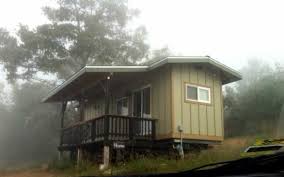
My hermitage ("Hesychia")

Sit in your cell as in paradise. Put the whole world behind you and forget it. Watch your thoughts like a good fisherman watching for fish.The path you must follow is in the Psalms — never leave it.
If you have just come to the monastery, and in spite of your good will you cannot accomplish what you want, take every opportunity you can to sing the Psalms in your heart and to understand them with your mind.
And if your mind wanders as you read, do not give up; hurry back and apply your mind to the words once more.
Realize above all that you are in God's presence, and stand there with the attitude of one who stands before the emperor.
Empty yourself completely and sit waiting, content with the grace of God, like the chick who tastes nothing and eats nothing but what his mother brings him.
It is easy to take this almost literally, here at New Camaldoli, where the view is nearly 180 degrees of ocean, flanked by steep mountains. 
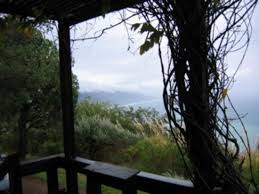
From my hermitage

One is reminded of Italy – an impression encouraged by numerous Italian cypress trees near the church. The silence is profound. As Meister Eckhardt observed, “There is nothing in the world so like God as silence.”  The stars are exceptionally brilliant, because of zero pollution, I suppose,.
Guests are offered self-service meals in the guesthouse, which can be taken to their cells or to nearby picnic tables. The cooking is superb: Italian vegetarian – everything homemade, simple, and fresh.
***************
Today’s prophecy and Gospel were the Creation and the account of our Lord’s healings in Galilee: everyone who touched Him was healed. It is God’s intention to repair the world through Jesus Christ. Lourdes reminds us of the concrete nature of this intention. It reminds us also of Baptism, by which the world is healed. The miraculous spring, which our Lady showed to St. Bernadette, is a type of our Baptism, as the preacher pointed out. He also emphasized the water and the wind of the Genesis story. Water and the Spirit.  To be born from above is to experience the mystical import of these natural necessities (water and air). They are communal we all breathe the same air and drink the same water. IN THIS SENSE, We ARE one another, in our physical nature. Air transfigured is Spirit. Water transfigured is the means of redemption and healing, as at Lourdes.


Obedience, Stability, Conversion – the three are pretty much the same – all references to attention to God.
Obedience = listening
Conversion = “”TURNING-WITH” or turning unto God.
Stability may refer not merely to stating in one physical place (one’s monastic home) but to overcoming the habit of mind that constantly looks forward to the next thing. In other words, stability =  be-here-now

The individual hermitages are given Greek names: Sophia, kairos, &c. Mine is hesychia, which I was able to choose. It was a fortunate choice, not only because of the view, but because of the theme of my self-guided retreat: stillness, which is the meaning of the name. By “accident”, I picked up two books just prior to my little retreat: New Seeds of Contemplation, by Thomas Merton, and The Cloud of Unknowing, in the Paulist Press edition. I found Merton at the Henry Miller Library down the road, and the Cloud here in the monastic bookstore.
On the theme of stillness, the annotation mentions a reference in the Cloud is to the Psalm: Be still and know that I am God. In Latin, the word is vacate. Vacatio = heschia; the emptiness of kenosis, which is the mind of Christ. Emptiness of mind is the aim of The Exercise, taught in the Cloud. So, the whole aim of the contemplative life is to try to go on vacation!
Merton points out that the solitary is never alone for himself, but in company with others. The Cloud insists that whatever progress any contemplative soul may make benefits the whole Church, and reduces the suffering of the soul in purgatory! Contemplation is, in the end, communal, even though all thought of any being other than God is beaten down into the “cloud of forgetting.” Merton goes on to observe that the saint is one who is dazzled by the reflection of God that he sees in everyone around him. Back to Irenæus and the reciprocity between the Life of Man and the Vision of God’s glory.
One might also ask about the proof-texts: “the second is like it” (Love of neighbor and love of God are alike, identical), and John’s observation that one who does not love neighbor cannot love God. Surely this is more than an observation that love of neighbor is a consequence of the love of God and a proof of it. To behold the neighbor, in Ross’s sense, is to love God. Therefore, the Kingdom of God IS among us – in our relationship of love – and not within us, severally, as individuals.
Merton argues that it must be so, because contemplation is granted only to those who do God’s will, and God’s will is that we love one another. So, it is in fact impossible to love God without compassion for all others. Without compassion, we love something other than God.
Merton insists on the distinction – indeed the opposition – between individual and person. (I wonder whether Starets Sophrony ever read Merton. Or maybe this distinction has another source – Heidegger perhaps? Or Kant?  

Friday, 18 January 2013

Sunny LA

After a terrific (but short), overnight visit with Eric and Karine and 3.5-year-old Liam in Montreal, I flew via Toronto to LAX. I checked in to a motel to get a good night's sleep. (I knew for sure I was in LA when, looking for something to read, I found a copy of the Bhagavad Gita in place of Gideon's Bible!).

The next day, my friend, Lev Rukhin, welcomed me to his loft and then left for New York. I am on my own for the weekend. Fine with me: Lever has a great library, wi-fi, and Netflix!

Lev Evgenievich Rukhin & daughter Evgenia Lvovna Rukhina

Lever, a fine cook,  also left directions to Fresh & Easy, his local grocer, which he described as the British version of Trader Joe's. The neighborhood is LA's version of Soho or our warehouse district - lots of converted space for lofts. But still lots of trucks and warehouses. lever's place is a big compound of conversions just for artists. Very cool.

Lever is a photographer:


His signature style is these big murals composed of smaller prints, which he calls "contextual photography." More on his website: check out the Galleries and Portraits menus for more fine pix, including several shot on his motorcycle tour through Russia, after which I met him by accident in 1999. 

We were both dumbfounded when we met at a cafe in Rome and discovered that we had met before in Leningrad! Lever's father, a noted Soviet Russian non-conformist painter, had invited the Yale Russian Chorus to a soiree at his apartment on the riverbank. Zhenia invited me back to meet a few friends the next day. Lever (short for Lev Evgenievich Rukhin) was six months old!

Lever and dad in Leningrad

Martinique, January, 2013


You wouldn't call Ste. Anne a “sleepy beach-front town”. There is nothing sleepy about it, except possibly in the mid-afternoon heat. The rest of the time the dozens of restaurants and tourist boutiques are going strong. And at night there is usually a live band somewhere around the square. It is a thoroughgoing tourist scene, even if most of the tourists are from the same country – France – or Quebec. Everyone speaks French and the euro is the currency, because Martinique is part of France, just like Hawaii is part of the United States.


“The Kingdom of the Banana” (la royaume du banane), and that is about it. There is still some sugar-cane, too – enough to support a dozen or so distilleries – but the Banana is King, for sure. 

The people are mostly poor (50% unemployment), but not miserable, due to the French socialist safety-net. This includes free universal health care and education, subsidized housing, and enough assistance so no one starves. The roads also get a lot of attention, which means work for a lot of people. In general, the Martiniquaises are doing a whole lot better than the Hatiians,  who freed themselves from French colonial control in the 19th Century. Makes you wonder.

You also have to wonder about the Christmas decorations – still on the lampposts, not because they are laid-back, but because, I suppose, the custom is to observe the season right through Epiphany (La Fête des Rois). What is to wonder about is the shimmering, white, electric snowflakes! No one here has ever seen snow. What do you suppose people think when they see them? My favorite seaside restaurant also has a nice little artificial Christmas tree.

Among things not found in Martinique, in addition to snow, are trains, irrigation, cut flowers, and hotels. There are lots of small buses on all the roads; it rains almost every day or night, at least this time of year; there are so many brilliant blossoms growing everywhere wild that I suppose no one bothers to cut flowers that would wilt pretty fast in the heat, anyway. Of course there are tourist accommodations, but none that advertize or make themselves known along the road. I discovered this on my foray to the volcanic North, 
La Pelée vue du Carbet.jpg
Mt. Pelée ~ active volcano
where I intended to find one and stay the night. I didn’t. Even towns marked “H” for hotel on the map kept them well-hidden. I suppose they are mostly resort-style facilities booked through agents or, now, online. Anyway, no motels or Holiday Inns. And no roadsigns inviting customers. Lots of signs for restaurants, but nothing about hotels. Not one. There is a Club Med right across the street from my rented studio, but no high-rise glamour-destinations. This ain’t Cabo or Cancun. I suspect the French have decided to keep it that way – low-key and under everybody-else’s radar. Still, it’s kind of odd. Every little town and suburb in metropolitan France, after all, has plenty of small hotels. I guess people here don’t get in their cars and drive around much, or if they do, they are never more than an hour or so from home. So, no motels.


The cuisine is pretty typically French: steak and fries, grilled chicken and fish, salads at the better places. Their local specialties are mainlyboudin noir (blood pudding), fluffy, light and mild, and acras


which are little fritters made of cod or shrimp. They seem to be a staple, sold at all restaurants and also by the side of the road, alongside BBQ brochettes and ribs. Bananas, of course, are to-die-for. I swear I have never had one as good. Could they be tree-ripened?

Saturday, 10 March 2012

Jardin Majorelle of Yves St. Laurent


Mohammed Abdullah, my driver, strongly suggested I take a look at the late couturier, Yves St. Laurent's villa, which he bequeathed to the City. The garden is a forest of bamboo, banana, palm, and cactus [mostly Sonoran]. The house, now the Musee Berbere, is  painted the designer's favorite color - a deep, electric blue - accented with lemon-yellow:


Thursday, 8 March 2012

Marrakesh


I am in my second week in Marrakesh, which is very much like AZ.  Architechturally, a cross between Santa Fe and Phoenix - in the new part - and pure Areabian nights in the old part. They seem to have a building code, so that everything - even high-rise hotels - have to look like adobe on the outside. The Medina (old walled city) seems authentic enough). lots of crenelated walls and square towers.

Since all they have beyond agriculture is tourism and phosphate, they are EXTREMELY jealous of their reputation for hospitality. They are very concerned that tourists have a good time. One feels utterly safe..  

Weather is beautiful, perfect. Great view of the Jupiter/venus conjunction from my balcony overlooking the pool. And birds. Birds, birds, birds. Noisy with birds in the garfdens surrounding the hotel, which has a rose garden, blooming oranges and lemons, lots of palms, of course, and  and a hibiscus hedge hugging the buildings. And this is costing me less than $30/day, including breakfast! Clean and luxurious.

But then,  as my students say, with nauseating persistence, "everything's relative". The Hotel Mamounia is luxurious at a level hard to imagine, with prices to match ($500-1,000/night). Have a look at their video. The first scene shows the table on one of their terraces where I had a $9 cup of coffee, while waiting for my $150 pedicure at the spa rated "best in the world" in 2011. Fortunately, it was all cosmetic, and they were unable to cut my toenails! So, I got a free foot-bath and foot-massage,, as a consolation prize. My $6 coffe was well worth it as trhe price of admission to this really unbelievable fantasy palace.

It is haerd to describe the "spa", but I'll try. First, I go into a kind of foyer: a long rectangular room, sheathed in white curtains, which blow in the breeze from the patio. There is a desk and a couple of white-clad attendants to show you to the elevator, which they summon and push the buttons for me. I come out in a dimly-lit cavern in deep, cobalt blue, named for some French-Moroccan designer. there are candle-lanterns on the floor of the arching hall-ways. eventually I arrive at the main desk, passing spacious, private massage rooms. The desk has a light-show projected on the wall behind it: a kind of kaleidescope, with arabesque patterns in many colors, slowly moving like fish in an aquarium. 

I am escorted to a room [about the size of my room at the cheap hotel], where I sit in a white-leather recliner. The masseuse starts to bathe my feet. Perfumed oil in the water, as I look at the odd, sharp-angled room design - light grey  walls, on which hang mirrors with coral, silver-studded frames. Then in came the matronly British manager to explain that the "best spa in the world" couldn't handle my toenails. But she was very gracious, calling a slightly less-seclusive spa to make an appointment for me [which worked out fine].

Moors in livery everywhere , opening doors, vigilant for ways to be helpful, kiosks carved out if marble, mosaics, tiles, elegant upholstery in the dark restaurants and bars, sunken fountains and water running out of faucets in the walls, acres oiof gardens witht he Atlas mountains in hte distance.

After this brush witih luxury and the "lifestyle" of the rich, I walked over to a souk (not a tourist trap, but where the Berbers actually buy stuff for themselves) and ate a humble but decent lunch with the ordinary citizens - for less than I paid for the luxury coffee.

Vegetarians would do well in Marrakesh. Most of my nightly dinners at the hotel consist of a beautifully-presented salad bar. easy enough to skip the chicken and beef, and just go for salads and pastries.


I took one excursion up into the mountains, where we visited a women's co-operative that produces all kinds of products based on the oil of a unique kind of almond. Cosmetics and cooking oil. The Atlas mountains are really spectacular, snow-covered, and high. They catch enough moisture to permit habitation to the west. East is the Sahara. I did see one Berber tent with camels!

we also had tea in a "typical" Berber house. Interesting enough. An adobe pueblo, for an extended family, with ceilings made out of vigas and  laterias, just like in AZ, only instead of saguaro ribs, the Berbers use bamboo for the laterias


An old guy made us some traditional ta in the patio.. First he put green tea into a big silver pot and added a bit if hot water. This he then poured out and added more hot water. When the second test was dark enough, he added loaf-sugar and stuffed in a whole fistful of mint branches. After a minute or so he gave ujs each a glass. Quite good.

They showed us the hamam, which is just a small, domed room built in such a way that there can be a fire under the floor, to heat it up for bathing.

I figured out that everyone here is really a Berber. It's just that the towns people have spoken Arabic for a thousand years, so the division is urban/rural. Berbers are what they call people whose native language is Berber. They are the indigenous people. The Moors (Arabs) are more cosmopolitan, with a bit of admixture from ethnic Arabs and black Africans.

Anyway, they are amiable people, and their government is benevolent despotism. They are poor, but not miserable. They are also young and energetic. Hassan II decided enough luxury was enough, and set a policy of one new dam a year, and universal education. the result is complete electrification and running water,k and a literacy rate of almost 70%. His son, the present king, Mohammed VI has promulgated a new constitution, which makes women and men completely equal, under law, and sets aside a block of parliamentary seats for women. School is free and open to all, but it is not compulsory, for some reason. Across the busy street from my hotel is the big technical university, and i see as many women as men going in and out.

So far, I have seen only three veiled women, and the rest seem to be evenly divided between those who wear hair-covering and those who don't. [It's kind of like Turkey, in this regard]. scarfless girls in blue-jeans tear around on motor-scooters. Obviously, no one is forcing anyone to wear anything. Lots of women wear scarves; lots of men wear  little Muslim caps. Lots more don't. It seems to be a matter of personal preference.

Apparently, there is a significant Sufi component in Moroccan Islam, never hassled by the government. Maybe this accounts for their fairly laid-back religious temperament. 


Now I'm off to arrange for a tailor-made jilaba (the hooded caftan that half the older men wear over their blue-jeans). They don't have my size off-the-rack, so I am having one made for not-very-much money, courtesy of a nice cab-driver. [All the cabbies are guides.]

here is the main square (where I saw actual snake-charmers, with shawms and live cobras!)